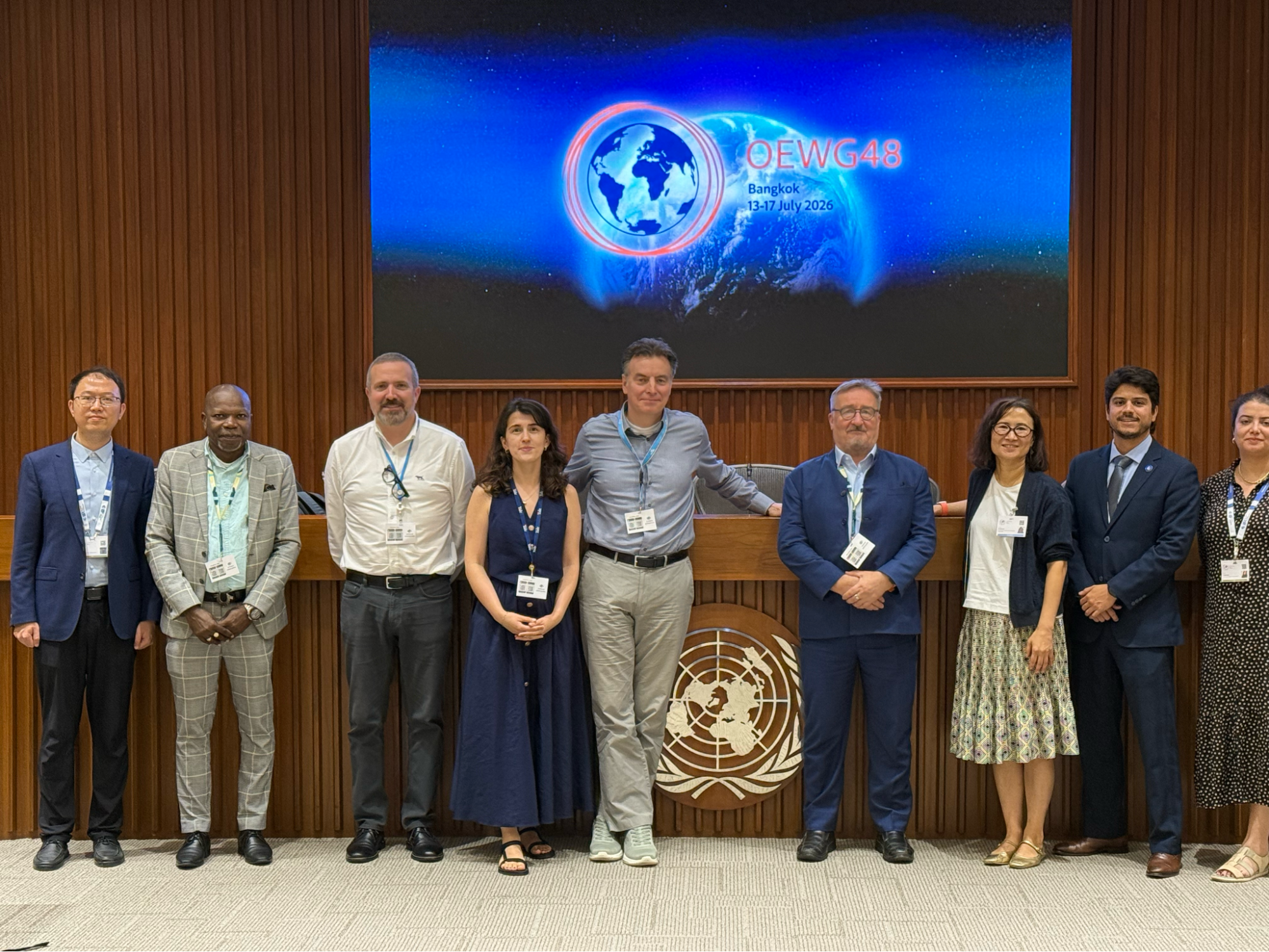
By: Öznur Öztürk and Anastasia O'Rourke
Global demand for cooling is projected to grow dramatically in the coming decades, bringing with it both enormous social benefits and significant climate challenges. While the Kigali Amendment is driving the transition to lower-global-warming-potential refrigerants, attention is increasingly turning to Alternative Cooling Technologies (ACTs), innovative approaches that have the potential to reduce reliance on conventional vapour-compression systems while improving energy efficiency and sustainability. But which of these technologies are ready today? Which technologies still require further research and development? And how can policymakers make informed decisions in a rapidly evolving landscape?
These questions brought together policymakers, researchers, industry experts, and international organizations during the 48th Open-ended Working Group (OEWG-48) in Bangkok, where the Carbon Containment Lab, the International Institute of Refrigeration (IIR), and the United Nations Industrial Development Organization (UNIDO) hosted the workshop "Unlocking Alternative Cooling Technologies at Scale: Towards Kigali+10 and Beyond." The event explored the state of ACTs today, the opportunities and barriers to their deployment, and how the Montreal Protocol community can help accelerate their uptake.
Looking Beyond Refrigerants
Opening the workshop, Maas Goote noted that cooling can no longer be considered just a comfort issue, but has become a basic necessity—raising the urgency of delivering cooling solutions. He reflected on the approaching tenth anniversary of the Kigali Amendment, highlighting it as a milestone that demonstrates what international cooperation can achieve in transforming the cooling sector. As the Montreal Protocol community looks beyond Kigali+10, he noted that there is an opportunity to broaden the conversation from refrigerants alone to the wider technologies that deliver cooling. ACTs can complement existing efforts by expanding the range of solutions available, particularly where they improve energy efficiency, reduce environmental impacts, or offer new approaches to meeting cooling demand.
Realizing this potential will require collaboration across research, industry, governments, and international organizations. It will also require a shared understanding of an increasingly diverse technology landscape, allowing policymakers to evaluate which technologies are best suited to different applications, climates, and economic contexts.
From Taxonomy to Market Readiness
Marco Durán Herrera introduced a new ACT taxonomy developed jointly by the Carbon Containment Lab, the IIR, and UNIDO. The taxonomy establishes common definitions and a structured classification for technologies that differ significantly in their operating principles, energy inputs, maturity, and applications. Rather than comparing technologies directly, the framework is designed to help policymakers and practitioners navigate this rapidly evolving field and will continue to evolve as new technologies emerge and existing ones mature.
Building on this foundation, Prof. Suxin Qian of Xi'an Jiaotong University and the Chinese Association of Refrigeration explored a question at the forefront of many participants' minds: which ACTs are ready for deployment today? Drawing on research and market developments in China, he highlighted technologies that are already demonstrating commercial potential alongside others that remain in earlier stages of development. His presentation underscored that continued research, demonstration projects, and investment will be essential to overcome technical and market barriers and accelerate the deployment of next-generation cooling solutions.
To complement the technical discussions, Öznur Öztürk of the Carbon Containment Lab introduced the Lab's Alternative Cooling Technologies Database and showcased videos of ACTs operating in real-world settings, including evaporative cooling, magnetocaloric cooling, and other emerging applications. Seeing these technologies in practice helped bridge the gap between laboratory research and real-world deployment, illustrating both their promise and the practical challenges associated with scaling them.
From Innovation to Implementation
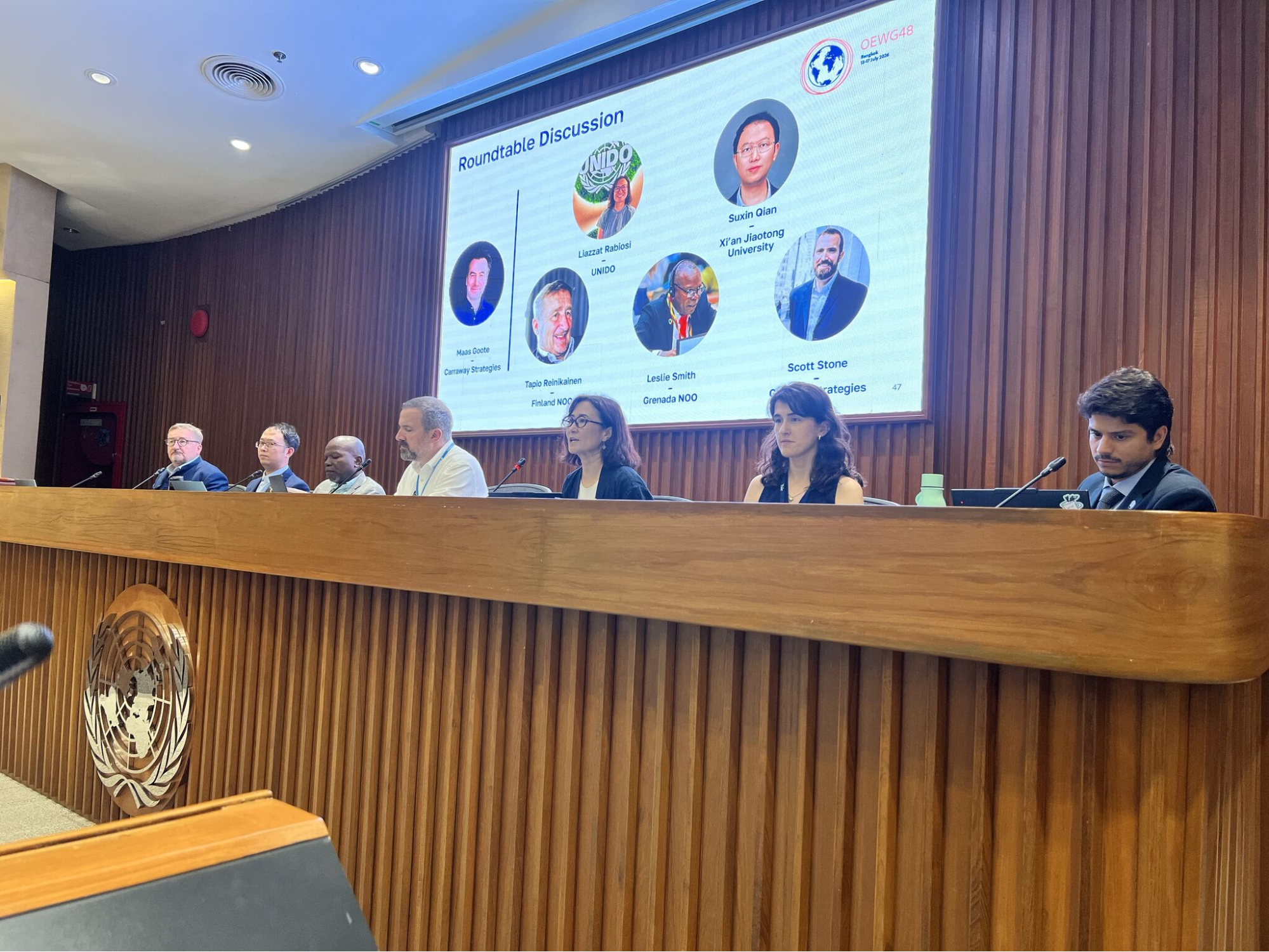
The roundtable brought together Liazzat Rabbiosi (UNIDO), Tapio Reinikainen (Finland), Leslie Smith (Grenada), Prof. Suxin Qian (Jiaotong University), and Scott Stone (Glencoe Strategies) to discuss the policy, financing, and institutional conditions needed to move ACTs from promising innovations to widespread adoption. The group noted that more than 75 percent of ozone-depleting substance (ODS) substitutes were not-in-kind, with the exception of cooling applications, which continue to rely on vapor compression technology. ACTs have the potential to change that, with participants acknowledging that many technologies are making significant technical progress; they agreed that scaling deployment will depend on more than innovation alone. Supportive policies, financing mechanisms, demonstration projects, technical standards, and stronger collaboration between governments, industry, researchers, and international organizations will all be essential. The discussion also reflected the growing momentum for ACTs within the Montreal Protocol community. In particular, they observed that ACTs have now been raised in Multilateral Fund discussions, but more work is needed to ensure they are appropriately considered for future projects. Finland shared its ongoing work exploring the contribution of ACTs to ozone and climate objectives and highlighted the Carbon Containment Lab's ACT Database as a valuable resource for policy development and research. Grenada offered the perspective of an Article 5 country, sharing its experience developing a district cooling project and illustrating the opportunities and challenges of introducing innovative cooling solutions in developing markets. Together with perspectives from China, the United States, and UNIDO, the discussion reinforced the importance of international cooperation in accelerating ACT deployment.
In her closing remarks, Souhir Al-Hammami of the IIR reflected on the breadth of expertise brought together during the workshop and emphasized the importance of maintaining the momentum generated by these discussions through continued collaboration and knowledge sharing.
Coming Soon: ACT Taxonomy Publication
The event highlighted an ongoing collaboration between Carbon Containment Lab, the IIR, and UNIDO to advance a common understanding of Alternative Cooling Technologies. Building on months of joint research and technical exchange, the three organizations are developing a taxonomy of ACTs that will provide a structured technology classification, a shared terminology, and an overview of technology readiness across different applications. The publication is intended to serve as a practical resource for policymakers, researchers, and practitioners, supporting evidence-based decision-making and helping countries identify technologies suited to their climatic, technical, and economic contexts.
Stay tuned for its release in the coming months.
Key takeaways of the event:
Several key themes emerged across the presentations and panel discussion:
There is no one-size-fits-all solution. Alternative Cooling Technologies should be viewed as a complementary portfolio of solutions, with different technologies suited to different applications, climates, and operating conditions.
Technology readiness varies considerably. While some ACTs are already commercially available or nearing market deployment, others require further research, demonstration, and validation before they can be adopted at scale.
A common framework matters. Shared definitions, robust classifications, and practical decision-support tools can help policymakers and practitioners navigate an increasingly diverse technology landscape.
Scaling ACTs requires more than technological innovation. Supportive policies, standards, financing mechanisms, and demonstration projects will all be critical to accelerating deployment.
International collaboration will be key. Continued cooperation between governments, researchers, industry, and international organizations can help accelerate innovation, share lessons learned, and build confidence in emerging technologies.
The Montreal Protocol should play an important enabling role. The Montreal Protocol offers the most relevant international policy forum for advancing ACTs. As countries continue implementing the Kigali Amendment, ACTs offer an opportunity to complement existing efforts and expand the range of sustainable cooling solutions available worldwide.
 Öznur Öztürk